As you may have heard, I recently made my 23andMe and Family Tree DNA autosomal testing results available for download online at “mygenotype,” and dedicated the information to the public domain (if dedicating DNA sequence to the public domain is even possible – I’m currently doing some research in this area and expect to write more in the future).
At “mygenotype” you can download the following:
My Family Tree DNA Results:
- Affymetrix Autosomal DNA Results (2010)
- Affymetrix X-Chromosome DNA Results (2010)
- Illumina Autosomal DNA Results (2011)
- Illumina X-Chromosome DNA Results (2011)
My 23andMe Results:
- V2 Results (2008)
- V3 Results (2010)
- Y-DNA Results (2010)
- mtDNA Results (2010)
You can also find my SNPedia Promethease reports:
- Promethease Report using an early version of Affymetrix Family Finder DNA Results
- Promethease Report using V2 23andMe DNA Results
- Promethease Report using pooled 23andMe and Family Finder DNA Results
In addition to my genome, Razib Khan of Gene Expression has a spreadsheet of approximately 48 other genomes that are available for download online.
A Challenge To YOU
Now that the information is out there, available to anyone who might be interested, it remains to be seen who might be interested in the information.
 In January I wrote about Benjaman Kyle, an amnesiac who was found on August 31, 2004 next to a dumpster behind a Burger King in Richmond Hill, Georgia. In that post, “
 I’ve been working on a presentation regarding the future of genetic genealogy, and one aspect of that future is the ability to trace DNA (SNPs, mutations, haplogroups, etc…) through recent history as the result of combining extensive genomic sequencing with massive family tree information. Although the ability to do this will have many uses (both for genealogy and for personalized medicine), it will also raise a number of privacy issues, as a recent paper suggests.


 I’ve long been interested in the success and long-term outlook of the genealogy market. Although altruistic genealogists have done immense amounts of work to transcribe and put records online, one of the strongest forces behind the digitization of genealogical records has been private profit-driven organizations. And these organizations, of course, rely on the viability of the market.
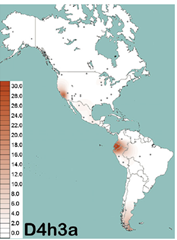 An international team of researchers have concluded that humans entered the Americas from Asia along at least two different paths. By studying two rare mtDNA haplogroups found in Native Americans – D4h3 and X2a – the researchers conclude that D4h3 spread into the Americans along the Pacific coast while X2a entered through the ice-free corridor between the