

23andMe and mondoBIOTECH announced at Davos (the World Economic Forum in Switzerland) today that they will work together to further the study of rare diseases. According to the press release (below), mondoBIOTECH will identify individuals suffering from certain rare diseases and sponsor their enrollment in the 23andMe Personal Genome Service™. Researchers will use the information collected to learn more about the potential causes of these rare diseases.
CNBC Video:
Linda Avey appeared on CNBC this morning to discuss the company and the partnership – see “It’s All in the Genes.â€
The Press Release:
Davos, Switzerland – January 28th 2009 – 23andMe, Inc., an industry leader in personal genetics, and Mondobiotech AG, a Swiss research company dedicated to the development of treatments for rare diseases, today announced at the World Economic Forum in Davos, Switzerland, that they are collaborating to advance research of rare diseases.
 I’ve long been interested in the success and long-term outlook of the genealogy market. Although altruistic genealogists have done immense amounts of work to transcribe and put records online, one of the strongest forces behind the digitization of genealogical records has been private profit-driven organizations. And these organizations, of course, rely on the viability of the market.

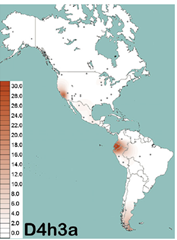 An international team of researchers have concluded that humans entered the Americas from Asia along at least two different paths. By studying two rare mtDNA haplogroups found in Native Americans – D4h3 and X2a – the researchers conclude that D4h3 spread into the Americans along the Pacific coast while X2a entered through the ice-free corridor between the
  I recently wrote about using genetic genealogy to potentially identify a male’s unknown surname. Although I had in mind using DNA to find an adopted male’s biological surname, the method has numerous other applications. For instance, it can be used in an attempt to identify the surname of a male who has forgotten his biological surname.